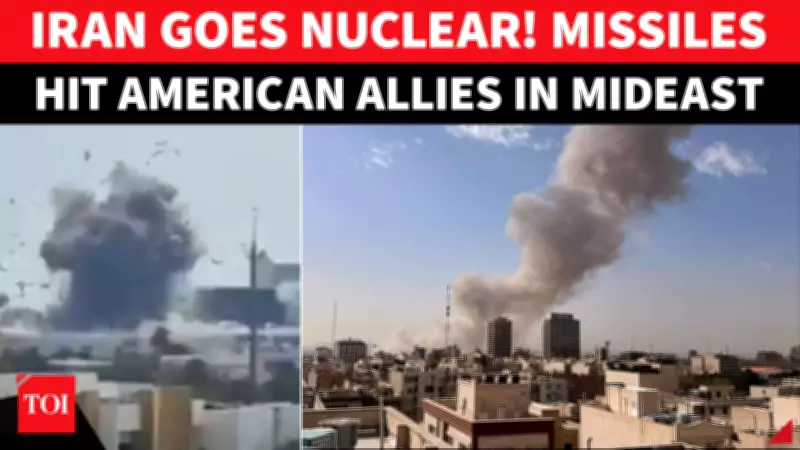
Iran Unleashes Missile Barrage on Gulf Capitals Following US-Israeli Strikes
The Middle East conflict has dramatically escalated into a regional confrontation after Iran launched a sweeping counter-assault in response to what it described as Israeli "preemptive" strikes. Iranian ballistic missiles reportedly targeted multiple Gulf states hosting critical U.S. military installations, triggering explosions across strategic locations and forcing widespread airspace closures.
Targeted Strikes on Key Gulf Capitals
According to regional reports, Iranian missiles struck targets in the capital cities of Saudi Arabia, the United Arab Emirates, and Qatar. Explosions were confirmed in Riyadh, Abu Dhabi, and Doha as part of what appears to be a coordinated retaliation campaign. The missiles specifically targeted major U.S.-linked military installations across the region, including bases in Qatar, Kuwait, the UAE, and Bahrain.
Civilian Casualties and Damage Reported
Authorities in the United Arab Emirates confirmed successful ballistic missile interceptions by their defense systems. However, falling debris from intercepted missiles struck a residential area in Abu Dhabi, resulting in one confirmed fatality and causing significant property damage. Emergency services responded to the affected neighborhood as security forces heightened alert levels across the country.

Regional Airspace Disrupted
The conflict has severely impacted regional aviation, with multiple countries suspending flights and closing their airspace as a precautionary measure. Airspace closures spread rapidly from Qatar to the UAE and Syria, creating significant disruptions to international air travel through one of the world's busiest aviation corridors. Airlines have been forced to reroute flights or cancel operations entirely.
Conflict Expands Beyond Initial Parties
What began as a confrontation between Israel and Iran has now expanded to involve multiple regional players. Jordanian forces intercepted missiles over their territory, indicating the conflict's geographical spread beyond the immediate Gulf region. The involvement of Gulf states hosting U.S. military bases has transformed the situation from a bilateral confrontation into a multinational regional crisis.
Strategic Implications and Regional Response
The missile attacks represent a significant escalation in Middle East tensions, with several critical developments:
- Direct targeting of U.S. military installations in allied Gulf states
- First confirmed civilian casualty from the expanded conflict
- Widespread disruption to regional aviation and commerce
- Involvement of multiple Arab states in what was initially an Iran-Israel confrontation
Security analysts note that the Iranian response appears calculated to demonstrate capability while avoiding direct confrontation with U.S. forces. However, the strikes on allied capitals have significantly raised the stakes and could trigger broader international involvement in the conflict.