

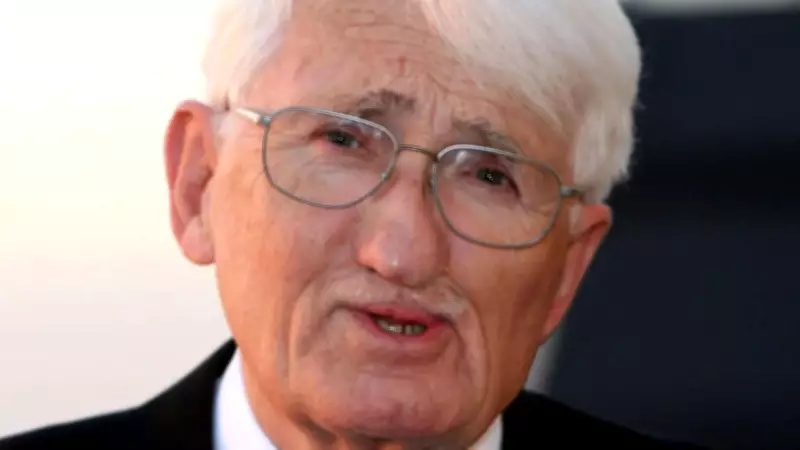
German Philosopher Jurgen Habermas, Influential Thinker on Communication, Dies at 96
The world of philosophy and social theory has lost one of its most significant voices. Jurgen Habermas, the German intellectual whose groundbreaking work on communication, rationality, and modern society influenced generations of thinkers, has died at the age of 96. His publisher, Suhrkamp, confirmed that Habermas passed away on Saturday in Starnberg, a town near Munich in southern Germany.
A Life Dedicated to Understanding Society and Communication
Habermas was not merely an academic philosopher confined to university halls. Over several decades, he actively engaged with political matters, using his intellectual framework to comment on contemporary issues. His extensive body of writing transcended traditional academic boundaries, weaving together philosophy, sociology, political theory, and linguistics to create a comprehensive vision of modern society and human interaction.
His most celebrated contribution remains the two-volume Theory of Communicative Action, published in the 1980s. This monumental work explored how communication forms the foundation of social coordination and rational discourse in contemporary societies. Habermas argued that through communicative action—where people seek mutual understanding rather than strategic manipulation—societies can achieve greater rationality and democratic legitimacy.

Personal Experience Shaping Philosophical Insight
Remarkably, Habermas's philosophical preoccupation with language and communication had deeply personal roots. Born with a cleft palate, he underwent multiple surgeries during his childhood. This challenging experience profoundly shaped his understanding of language's role in human existence.
Habermas often reflected on how his speech difficulties made him acutely aware of spoken language as "a layer of commonality without which we as individuals cannot exist." He recalled the struggle to make himself understood, an experience that informed his theoretical work on intersubjective understanding. Interestingly, he also spoke about the "superiority of the written word," noting that "the written form conceals the flaws of the oral"—an observation that perhaps stemmed from his personal challenges with speech.
Legacy of an Intellectual Giant
Jurgen Habermas's influence extended far beyond Germany, making him one of the most cited and discussed philosophers worldwide. His ideas continue to resonate in numerous fields:
- Political Theory: His concepts of deliberative democracy and the public sphere remain central to contemporary political discourse.
- Sociology: His analysis of modern society's structures and communication patterns influenced sociological methodology.
- Philosophy: He bridged continental and analytical philosophical traditions, creating a unique synthesis.
- Communication Studies: His theories about communicative action and rationality transformed how scholars understand human interaction.
As news of his passing spreads, tributes are pouring in from academic institutions, political thinkers, and public intellectuals across the globe. Habermas's death marks the end of an era for German philosophy, but his ideas about communication, rationality, and democratic society will undoubtedly continue to inspire and challenge future generations. His work remains essential reading for anyone seeking to understand the complexities of modern social life and the possibilities for more rational, democratic forms of human coexistence.

